Core Elements
Four core elements
The COS banking platform is built on four foundational elements that work together to deliver banking services. Understanding how these elements relate to each other is essential for integrating with Cross River.
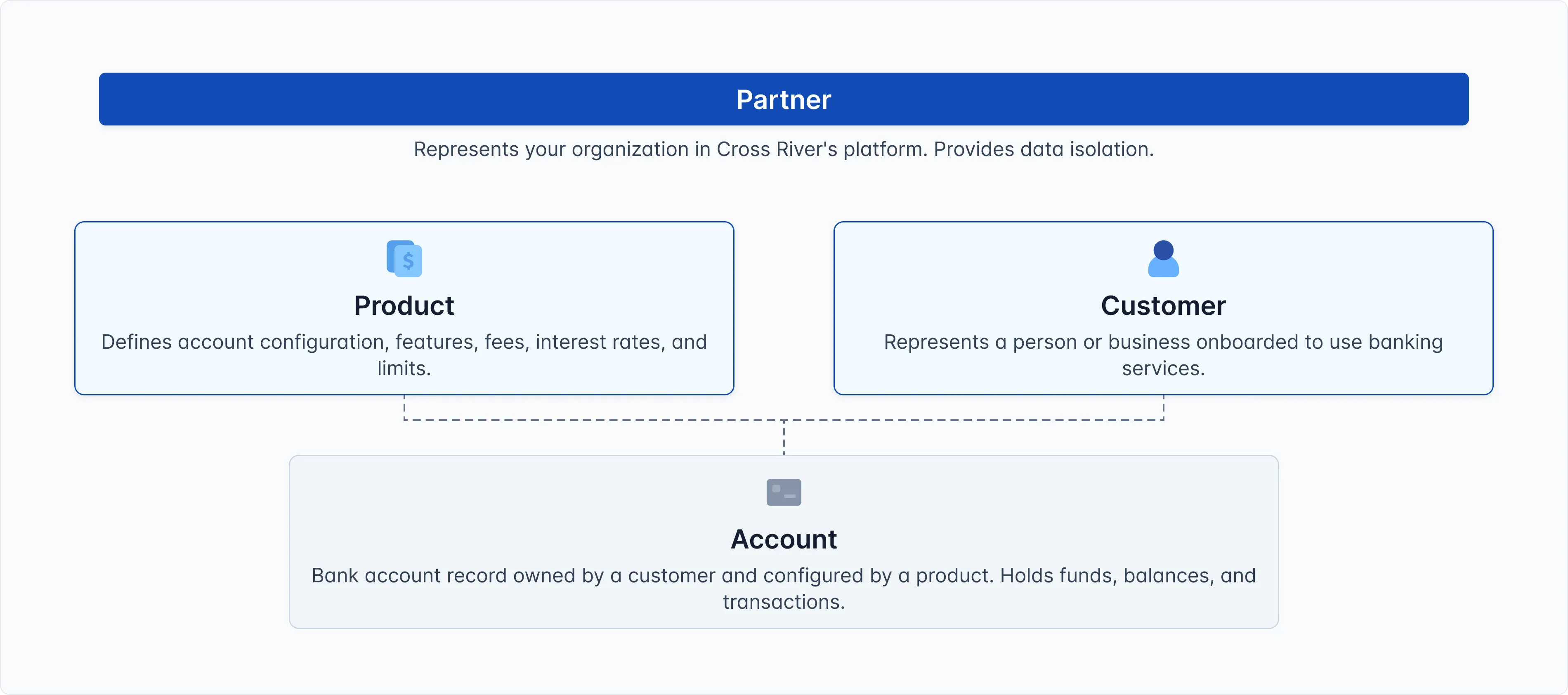
Partner
A partner, which is created by Cross River, represents your organization within Cross River's platform. Every product, customer, and account belongs to exactly one partner, providing complete data isolation and a barrier from other organizations.
Product
A product is contained in a product type which is a template that defines how a type of account is configured. The product is configured to define features, fees, interest rates, and limits that all accounts under that product inherit. When you offer an account, such as, for example, "Premier Checking" it will contain a template which contains a number of products (ACH, Wires, RTP, etc.).
Customer
Your customer represents a person or business you onboard to use your banking services. Customers store identity information, pass KYC verification, and can have multiple accounts across different products. Customers are added as relationships to accounts, and there are several relationship types such as Tax owner, Primary Customer, Joint Account and Payable on death.
Account
An account is a bank account opened for a customer under a specific product. In general, accounts hold funds, track balances, and record transactions. Every account links a customer (who owns it) to a product (which defines how it works).
Element relationships
The core elements are connected within a partner workspace. A partner is the top-level container for products, customers, and accounts. Products, customers, and accounts are each associated with one partner and are not shared across partners.
Relationship model
Within a partner workspace, products define account configuration, customers represent account owners, and accounts are the operational records that connect a customer to a product. The account is associated with the same partner as both the customer and the product.
Quick reference
Element 1 | Element 2 | Relationship | What this means |
|---|---|---|---|
Partner | Product | 1:Many | A partner can define multiple account offerings, such as checking, savings, or payment products. |
Partner | Customer | 1:Many | A partner can onboard many individuals or businesses that use its banking services. |
Partner | Account | 1:Many | Accounts are created and managed under one partner, together with that partner’s products and customers. |
Product | Partner | Many:1 | The product is available only for that partner and uses that partner’s configuration. |
Product | Account | 1:Many | Many accounts can use the same product setup, rules, and configuration. |
Customer | Partner | Many:1 | The customer record is managed under one partner and is not shared with other partners. |
Customer | Account | 1:Many | A customer can own more than one account, including accounts under different products. |
Account | Partner | Many:1 | The account is managed under the same partner as the customer who owns it and the product that defines it. |
Account | Customer | Many:1 | The customer is the legal or business owner of the account. |
Account | Product | Many:1 | The account uses the product’s configuration, such as features, fees, limits, and rules. |
Key point: Account ownership
Account ownership belongs to the customer, not to the product. The product determines how the account behaves, including its configuration, features, fees, limits, and other rules. The customer owns the account, while the account uses the product configuration.
Next steps
To learn more about each element:
- Partner: Understand your organization's environment
- Product: Configure account types and templates
- Customer: Onboard individuals and businesses
- Account: Open and manage bank accounts