Balance and ledger models
Balance models at a glance
Three balance models categorize partner-managed programs. The model depends on who holds the funds and the ledger location.
| |||
|---|---|---|---|
Cross River holds funds | No | Yes (FBO) | Yes (FBO) |
FDIC insurance for individual customer balances | No (customer funds not at Cross River) | Yes (pass-through) | Yes (pass-through) |
Daily balance file | No | Yes | Yes |
Balance visibility/sync | N/A | Partner syncs customer balances into FBO account subledgers | Partner provides balance file for reconciliation |
Daily transaction file | Yes | Yes | Yes |
Chargeback file | Yes | Yes | Yes |
All partner-managed programs require daily transaction files for monitoring. Balance visibility requirements depend on whether Cross River holds customer funds. Refer to Reporting and compliance for other applicable reports.
Choosing your model
The right model depends on your program structure.
- Card only BIN sponsorship: Cross River does not hold customer funds.
- FBO subledger model. Cross River holds funds and maintains subledgers while you sync balances. Choose this model if you require access to Cross River payment rails other than ACH. Subledgers are fully routable accounts that provide access to all Cross River payment rails.
- Pooled FBO account model: Cross River holds funds and you maintain the ledger with daily files.
All models where Cross River holds funds require balance visibility. This ensures FDIC pass-through insurance applies. Refer to Balance visibility for regulatory context.
Card only BIN sponsorship
Cross River only sponsors the BIN and facilitates network settlement. Customer funds live elsewhere, at a different bank, in pre-funded accounts, or sourced just-in-time from external systems, such as warehouse credit lines. This model is used in BIN sponsor credit card programs, where Cross River holds no funds.
Characteristics:
- Cross River does not hold customer funds
- No FBO account at Cross River for customer balances
- No balance file or balance sync required
- No pass-through FDIC insurance for individual customers
Use this model when:
- Customer funds stay at a different financial institution
- Your program uses external funding sources
- You need Cross River's BIN but not its banking infrastructure
Balance synchronization
Since Cross River does not hold funds for this model, there is no need to synchronize balances.
Reconciliation checks
This model has no FBO reconciliation requirements.
Cross River Operations contacts you each business morning. They provide the amount due for settlement.
Fund your network settlement accounts on time with the exact settlement amount.
FBO subledger model
Cross River holds customer funds in an FBO account with subledgers. You maintain your program ledger externally. You also update individual customer balances in COS at the subledger level through the balance and synchronization process. Cross River becomes the system of record through these subledgers.
Characteristics:
- Cross River holds funds in an FBO account (maintains subledgers in COS)
- You sync balance changes to subledgers
- Each customer has a subledger in COS
- Supports all payment rails
- Daily balance and transaction files are required
Balance file requirements:
- Sync balance changes through the core/v1/transactions endpoint.
- Sync at least once daily. High-volume programs may need multiple syncs per day.
- Each sync reflects net balance changes at the subledger level.
- An implicit subledger acts as a clearinghouse for reconciliation.
Balance synchronization
If you use the subledger model, you must synchronize balances in Cross River. We require this model:
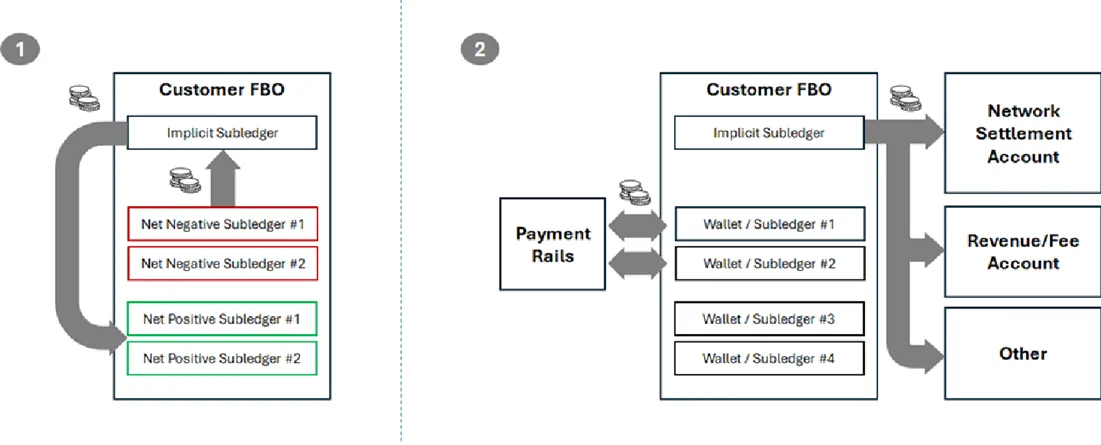
The implicit subledger balances all other subledgers. The system posts net credits as debits to the clearinghouse. Net debits post as credits from it.
Small residual or timing differences may appear. These accumulate in the implicit subledger. They represent your program-level net position.
Use your FBO account's implicit subledger as a clearing house. Each customer subledger that changed during the day posts one book transfer. That transfer goes against the implicit subledger.
This keeps the load light. Each changed subledger updates only once per cycle. The number of transactions does not matter.
Reconciliation checks
- Subledger balances must match your internal customer balances.
- Total subledger balances must reconcile with the FBO balance.
- Total debits must equal total credits within rounding tolerance.
Cross River Operations contacts you for major discrepancies. Cross River will also alert you if funds do not cover network settlement.
FBO pooled account model
Cross River holds customer funds in an FBO account with subledgers. You maintain your program ledger externally. You provide individual customer balances to Cross River through daily balance files. These files give Cross River visibility into beneficial ownership for FDIC pass-through insurance.
Characteristics:
- Cross River holds funds in an FBO account
- You or your processor maintain the program ledger
- A daily balance file maps each customer ID to a balance
- The file satisfies the FDIC beneficial owner identification requirement
Balance sync requirements:
- You or your processor provide the file, depending on who holds the program ledger.
- The file must show each customer's insured balance that Cross River holds.
- Deliver the file daily via SFTP
- Use CSV format according to Cross River specifications
- The file must reconcile to the total FBO balance
Balance synchronization
Post daily net balance updates into your FBO. These updates must reflect all activity external to Cross River that affected any card balances from your program.
Reconciliation checks
Confirm your total FBO account balance matches the sum of all card balances from your program. This amount must also match what you report in the daily card balance file.