Send payment
Flow of funds
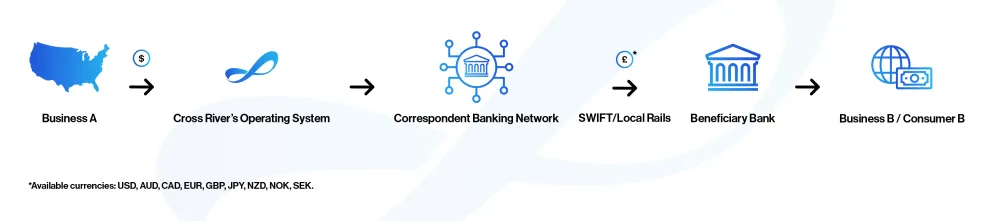
Outbound payments
See our tutorialtutorial to learn how to send an international payment.
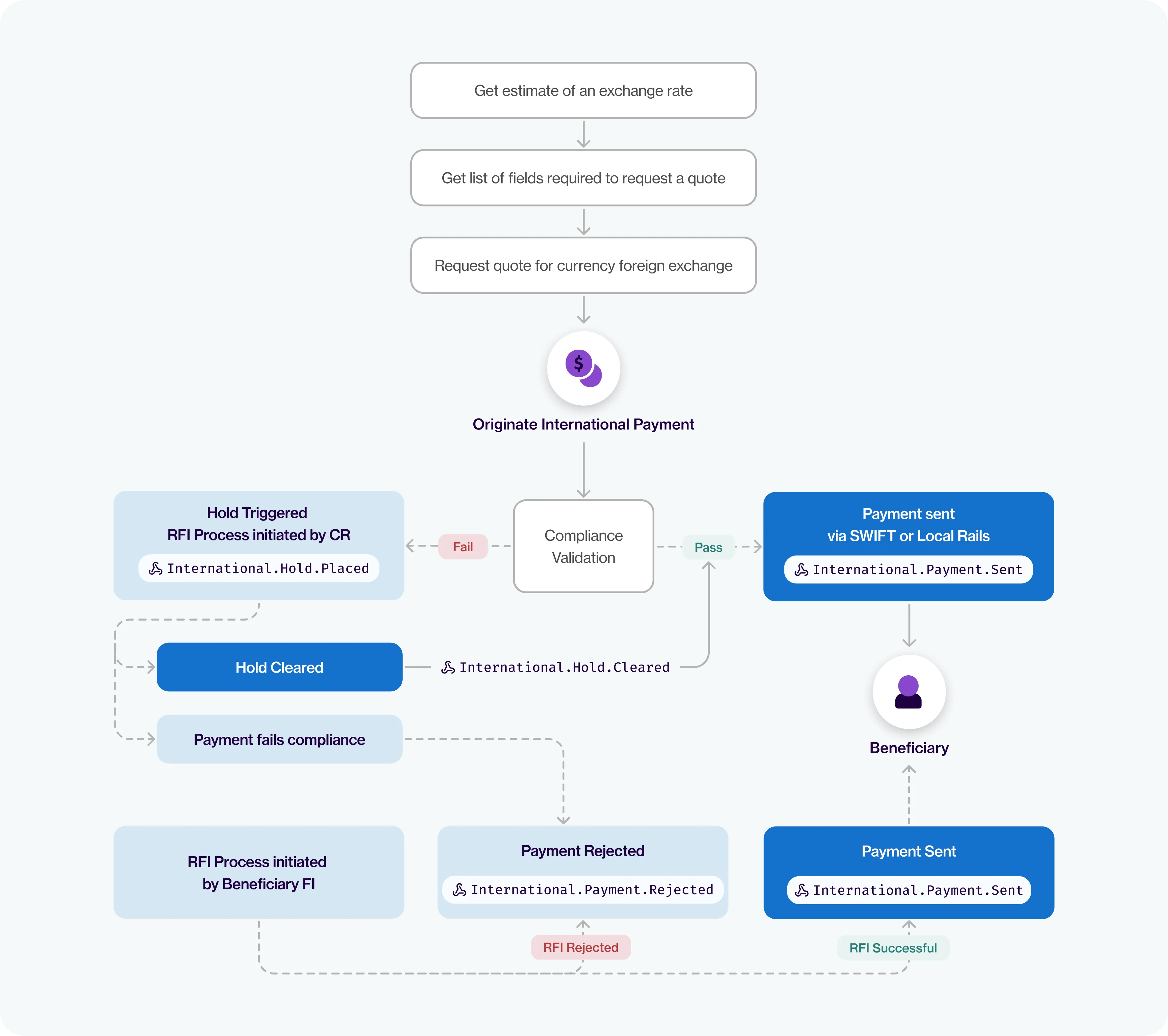
The following diagram shows the status and webhook flows for outbound International Payments:
How it works
Step 1: Obtain Exchange Rate Estimate
Before committing to sending an international payment, you can obtain an estimate of the exchange rate. The estimate includes the current FX rate, with spread and transaction fees. This step does not require beneficiary data.
Step 2: Verify Requirements for Quote
Once satisfied with the exchange rate estimate, you can use the get list of required fields for quote request API to validate the specific attributes/information required for creating a valid quote. This step is crucial as international payment requirements vary by country.
Step 3: Generate Executable Quote
- After gathering the necessary requirements for a quote, you request a payment quote. The quote includes the transfer cost, fees, and the exchange rate for a foreign currency. Beneficiary details are required, and the quote is valid for a limited amount of time (60 seconds).
- It is mandatory to Include the originator details.
- For any payments to Mexico:
- The accountNumber and iban fields must be left blank.
- routingCodeType1 must be CLABE
- routingCodeValue1 must be the 18 digits CLABE number.
- All outbound payments where the “To” currency is one of: INR (India), MYR (Malaysia), and AED (United Arab Emirates) require the use of the Payment Purpose Code field to be populated with the corresponding PPC for the respective currency.
- The generated quote ID is essential for the next step.
Step 4: Originate International Payment
Using the obtained quote ID, you use the originate a payment originate a payment endpoint to initiate an international payment. The payment process involves clearing holds, acceptance of conversion, and eventual completion. You are notified via a webhook about the acceptance or rejection of their payment.
Some payments may trigger holds or require additional information from the recipient bank, initiating an RFI (Request for Information) process. Completion of the RFI process is necessary for payment completion. Customers are notified of payment rejection, if any, with reasons provided via a webhook.