Participant roles
Participant roles
A payment is simply money moving from one account to another — but whose payment is it, and who is it for?
For straightforward payments those questions have the same answer. A business pays its supplier: the business owns the account being debited, and the business is the one making the payment.
Many payments are more complicated. A platform sends money out of its own account for one of its merchants. A marketplace receives money into its own account for one of its sellers. In both cases the account holder and the party the payment concerns are different parties.
Payments identify each party by a role, using ISO 20022 terminology.
Debtor. The party whose account is debited. This is the account holder: whoever owns the funds leaving the account, and whoever the network holds accountable for the payment. If you send payments from your own account, the Debtor is you — your legal business name.
Ultimate Debtor. The party the payment is actually being made for. This is the role you use when you're moving money for someone else — your merchant, your customer, the person whose obligation is being settled. The Ultimate Debtor doesn't own the account; they own the reason for the payment.
When the account holder and the party being paid for are the same, you only need the Debtor. When they differ, you need both.
Creditor. The party whose account is credited. The account holder on the receiving end.
Ultimate Creditor. The party the money is ultimately intended for, when that differs from the account holder. Sending to a marketplace that holds funds on behalf of one of its sellers is the classic case: the marketplace is the Creditor, the seller is the Ultimate Creditor.
The roles at a glance
Role | Who it is |
|---|---|
Debtor | The account holder whose funds are leaving |
Ultimate Debtor | The party the payment is being made for |
Creditor | The account holder receiving the funds |
Ultimate Creditor | The party the funds are ultimately for |
Business or individual
The Ultimate Debtor and Ultimate Creditor are parties, not accounts. They are identified by name, and optionally by an identifier and an address; neither holds an account at Cross River. Either can be a business or an individual — there is no requirement that they match who the Debtor or the Creditor is.
A business Debtor sending for an individual is a normal arrangement — a platform that operates wallets holds the funding account in its own name, while the party each payment is made for is an individual wallet holder. The platform is the Debtor; the wallet holder is the Ultimate Debtor.
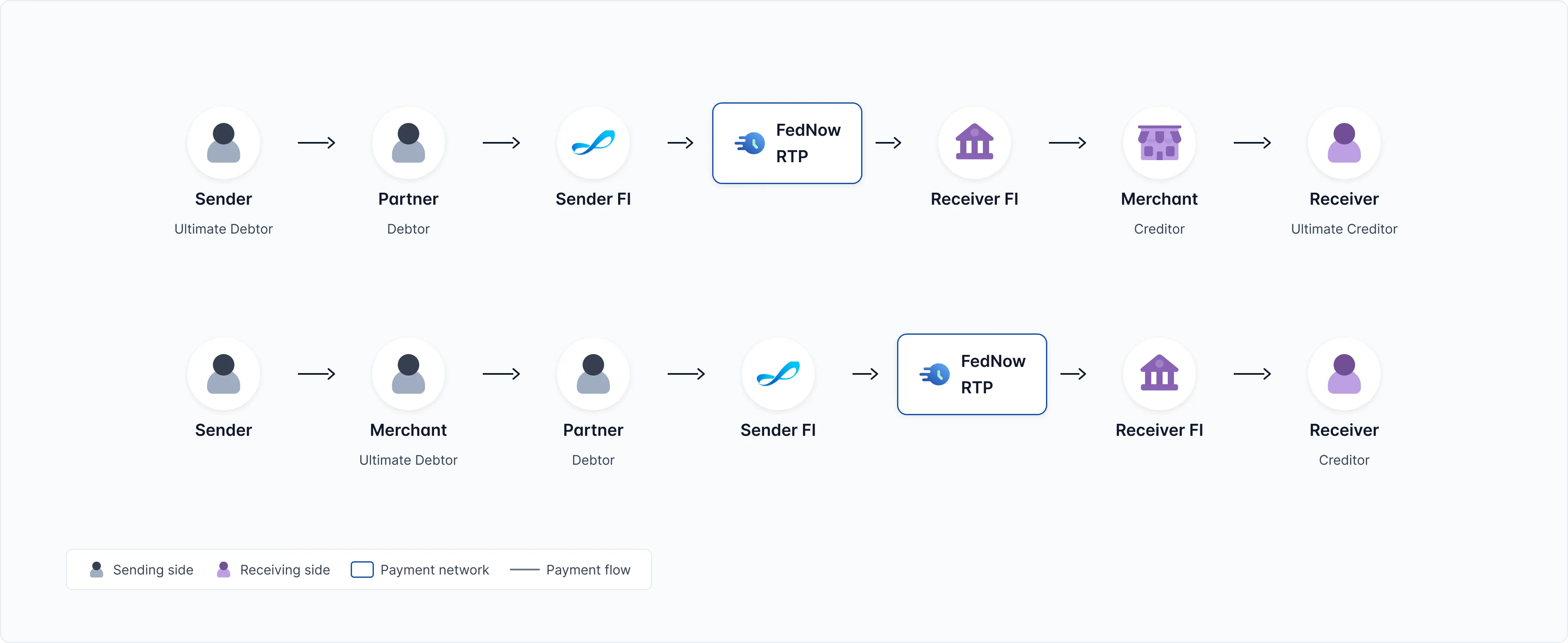
Three worked examples
A business pays a supplier directly. The business owns the account and is making its own payment, so it is the Debtor. The supplier owns the receiving account and is the intended recipient, so it is the Creditor. No Ultimate parties are needed.
A platform pays a supplier for one of its merchants. The platform owns the funding account, so the platform is the Debtor, under its own legal business name. The merchant is the party the payment is being made for, so the merchant is the Ultimate Debtor. The supplier is the Creditor. All three roles carry distinct information, and dropping any one of them would misrepresent the payment.
An end user pays through a merchant's app, and you send the payment. The end user is the party the payment is being made for, so the end user is the Ultimate Debtor. You hold the funding account, so you are the Debtor, under your own legal business name. The party being paid is the Creditor. Note where the merchant sits: if the merchant is simply the app the end user tapped, the merchant is not a party to the payment at all. A facilitator is only an Ultimate Debtor when the payment is settling the facilitator's own obligation, not when it is passing along someone else's.
What the rules require
The RTP Operating Rules set this out directly. Three requirements follow from them:
• The Debtor must be identified by its own legal name. Descriptive constructions that merge the account holder with the party being paid for do not satisfy this.
• The Ultimate Debtor must be identified whenever a payment is made on another party's behalf, using that party's legal name.
• Name fields carry names. Reference numbers, order identifiers and customer IDs belong in the remittance information that travels with the payment, not in a name field.
The RTP network's customer display requirements govern which party names a receiving bank makes available to the recipient. Identifying the Ultimate Debtor correctly is what puts your customer's name on the payment as the party it was made for.