Subledgers
Cross River subledger solution
Cross River gives you the ability to open a subledger instantly and on-demand. A subledger is linked to a master account, usually an FBO. Subledgers (sometimes referred to as subaccounts or virtual accounts in the broader Fintech industry) allow segregation of funds within the FBO/Master account. Each subledger is assigned its own account and routing numbers so that payment transactions (such as ACH, Wire, or RTP) can be originated from or received by the individual subledger. This allows partners who use FBOs to create a bank account-like experience for their customers, unlocking payment and card experiences.
In subledger API endpoints, the term subaccounts is used instead of subledgers. For instance, POST /v1/dda/subaccounts.
What is a subledger
A subledger is a virtual account that sits under a master account (usually an FBO). This means that any activity on the funds in the subledger are reflected as activities of the main account. However, the subledger can have a beneficiary who is not the owner of the main account. This makes subledgers an ideal way for you to send and track payments for your end users (customers), instead of maintaining a separate deposit account for each one. A single FBO account can have a very large number of subledgers.
In the Cross River banking core, a subledger is a first-class citizen, meaning it supports all the operations available to accounts. All transactions first go through the subledger, followed by the master account.
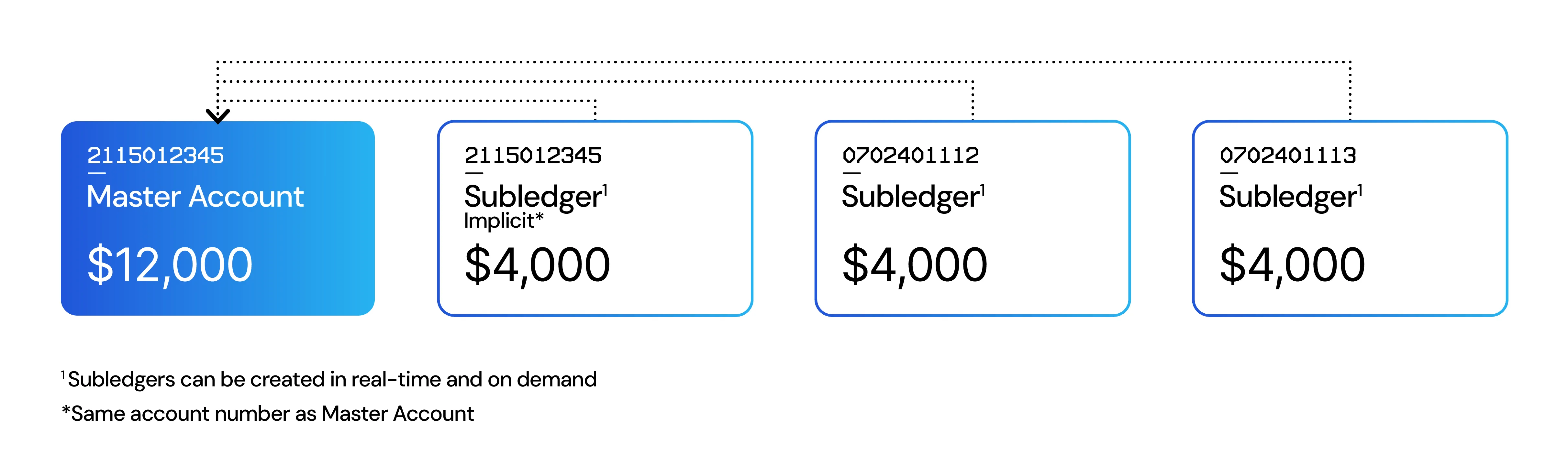
There are a few types of subledgers. Funds flow into and out of each more or less the same way, but with certain specific differences. All the subledgers under a single master account always sum to the balance of the master account. It is virtually impossible for a master account and its subledgers to be out of balance. The figure below illustrates the relationship among the subledgers (subaccounts).
The subledger and master account balances are updated atomically and never out of sync. Funds posted to a subledger are immediately available
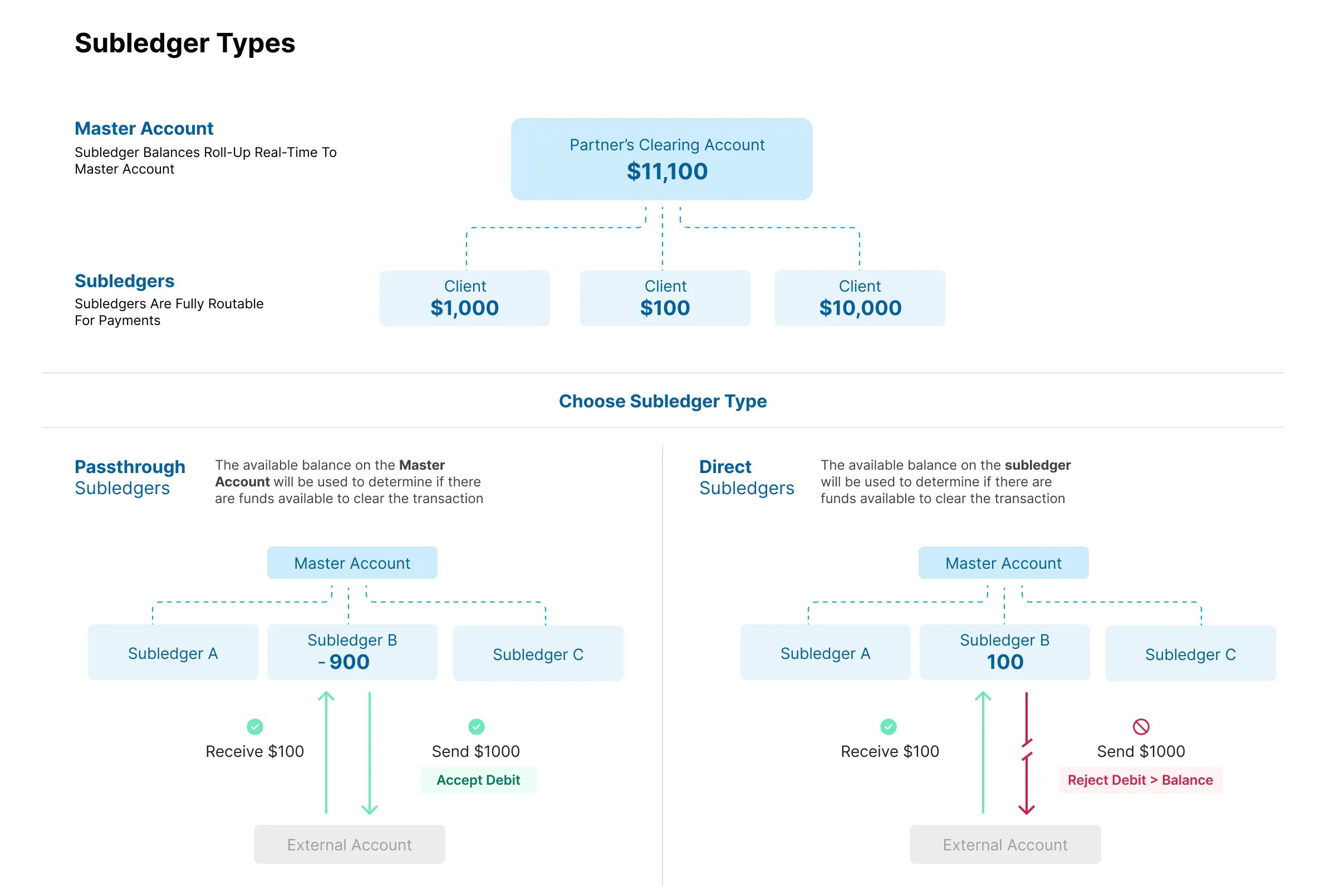
Subledger types
In Cross River, there are a few different types of subledgers:
- Implicit
- Passthrough
- Direct
Implicit subledgers
Every master account has what is called an implicit subledger, which is automatically created and maintained. The implicit subledger accounts for the portion of the balance directly attributed to the master account's activity and has the same account number as the master. The implicit subledger is how the Cross River banking core ensures that all the subledgers sum to the master account balance.
If more funds are attributed to other subledgers than directly in the master account, the implicit subledger account balance could go negative.
Passthrough subledgers
A passthrough subledger does not require a sufficient balance to fulfill a payment or transaction request. In other words, a passthrough subledger can have a negative balance. The banking core relies on the master account balance to determine whether to fulfill the request or not.
Even if a specific subledger doesn't have enough funds to send a payment, the payment goes through if the master account has the funds.
Your onboarding manager will guide you in your configuration, based on your operational model and funds flows.
Direct subledgers
Under a direct ledger configuration, unlike passthrough subledgers, the banking core uses the subledger balance in transaction decisions. This means that a payout that exceeds the subledger balance will be rejected by COS.
Comparing direct and passthrough
Key Features | Passthrough | Direct |
|---|---|---|
Instantaneous rollup of transactions to the master account balance | Y | Y |
Fully routable on all payment rails (for example, ACH, Wires, instant payments) | Y | Y |
Supports webhooks on subledger events (such as inbound transactions) | Y | Y |
Reflects balance of transactions cleared against account | Y | Y |
Subledger can carry a negative balance | Y | N |
Will allow transactions to clear against subledger when balance < $0 (as long as the master account has sufficient funds) | Y | N |
Best for model where funds availability is managed at the subledger level | N | Y |
Best for model where funds availability is managed outside of subledger with need for visibility and efficiency of transactional flows with co-mingled funds | Y | N |
Subledger funds flow
The following example shows funds movement in a master account with 2 passthrough subledgers.
In this example, a checking account has been opened with an initial deposit of $500. Note that an implicit subledger with the same number has been created and is tracking the balance of the master.
Master Account # | Subledger # | Balance |
|---|---|---|
2000012345 | -- | $500 |
| 2000012345 (Implicit) | $500 |
Next, two subledgers are created at the request of the partner:
Master Account # | Subledger # | Balance |
|---|---|---|
2000012345 | -- | $500 |
| 2000012345 (Implicit) | $500 |
| 300007770001 | $0 |
| 300007770002 | $0 |
A wire for $500 is then sent to each of the subledgers:
Master Account # | Subledger # | Balance |
|---|---|---|
2000012345 | -- | $1500 |
| 2000012345 (Implicit) | $500 |
| 300007770001 | $500 |
| 300007770002 | $500 |
Finally, an ACH for $1,000 is pulled from the master account directly:
Master Account # | Subledger # | Balance |
|---|---|---|
2000012345 | -- | $500 |
| 2000012345 (Implicit) | ($500) |
| 300007770001 | $500 |
| 300007770002 | $500 |
Note that the implicit subledger is now negative; however, the sum of the subledger still correctly reflects the master account's balance. It is good practice to transfer subledger funds to the master account before spending the money. Ideally the implicit balance should match the master balance.
No bank statement
Subledgers are essentially temporary holding places for funds before they move into or out of the master account. Therefore, there is no way for the system to generate a statement or balance report for a subledger.
To substantiate a subledger balance, the sum of all subledger balances must total the master account balance. Since subledgers do not settle, their activity does not re-sequence like that of the master account. Therefore, there is no way to produce a historical record of subledger balance history.